Plan for a progressive victory

At the last general election, I built a tiny website and campaigning tool called I’ll Vote Green If You Do. It attracted quite a bit of attention and coverage, including The Guardian (here and here), Cory Doctorow (here), and even Breitbart (here).

I built it in 2 hours or so (I was on a train and bored) to show how it’s not how pretty something is, or how sophisticated the thinking behind it – all it takes is a simple, coherent, positive message, and an incentive to share (and a belief that it might actually make a difference). If I were to do this again, I would make many, many changes, but the one I built signed up 30k people or so in a couple of weeks, got the attention of plenty of media and eventually The Green Party itself…

Focus

The focus of what I did before was not tactical, however, it was about working out the psychological/behavioural triggers that encourage the viral spread of concepts in a pool of otherwise lukewarm prospects. Having now spent 6 years building digital fundraising programmes for nonprofits, I’ve codified a bunch of that knowledge into how to generate a lot of noise for a campaign without spending any money on broadcast/push media.

The tool I built for the last election had a very simple sign up for (name, postcode, email), which then mapped the postcode to a constituency, registered your intention to vote green, and then gave you social sharing tools coupled with tracked links which you could send out on social, to friends, etc. Because those links were tracked, you knew when someone else signed up (as did the site) as a result of your promotion, and you got an email to tell you this – your referred person then got their own links, and the cycle repeated.

The Problem This Time

To some extent, it’s the same as last time! Only harder. The problem that progressives are facing at this election is messaging. There is none. There are fragmented opinions expressed chaotically, and most of the attempts to unite the progressives are either:

  • vague and unspecific with negative undertones – e.g. More United, Progressive Alliance – “Let’s build a new politics together” etc
  • straight up negative – e.g “Stop the Tories”

Vague messaging doesn’t work because it’s not a story that can be retold. Try explaining to someone what “Let’s build a new politics together” means, without saying “What we have is broken and has been for f***ing ever”. All of the messaging gets lost in the context, because it’s a backwards-justified negatively-based argument. You cannot shoot for the moon if there is no moon. What we have here is a bunch of people calling for change without telling us where this change is going. Whilst that might have worked in a broadcast-era world, what makes opinion spread in a world where social influence rules is a story that can be internalized (which for most people means visualized, which requires something in the future, not the past) and retold (which requires positivity if any action is required).

Examples from Fundraising

An example from fundraising – an advert of a starving child will make you donate, but you will not take a photo of that advert and send it to your friends to get them to donate, because it’s negative, even if you were personally triggered to action. However, a street musician playing some beautiful music in the street on an instrument you don’t know will also make you donate, and you’ll take a photo or a video and send to your friends along with your location to share the experience. Whilst this is a simple example which is a bit straw-man-like, it’s how stuff spreads now – and it matters hugely, because spheres of social influence have overtaken spheres of institutional influence in most peoples’ lives (for reference, think of the influences of the bubbles of Facebook on both the Brexit and Trump votes).

So What Now?

What we actually need now is a vision of the future defined in its own terms, not in terms of how much better it is than now. “Imagine a fairer society” – NO! Instead – Imagine a FAIR society. And to make this stick, what is needed are the stories that exemplify and emotionally connect people to it.

It doesn’t particularly matter what this cause we – as progressives – find and unite behind. It could be equality, environment, education, or a whole host of other things. It just matters that we find it.

My view is that progressive politics needs to unify around a simple, positive cause. My bet is on education as the central point of a progressive manifesto. This post won’t reach those writing the policy for the variously and pointlessly infighting progressive factions, I’m sure.

But if you know them, no harm pointing them at it.
Standard

Ban… what ban?

My fiancee, Kiran, flew into Boston yesterday on a separate flight, with a view to spending some time out here accompanying me on my WCMT trip. For weeks we had been very nervous about this – the Trump Executive Order seemed a real threat to her travel. Being a Pakistani national with a visa didn’t do much to reassure us, but in the end, it was me that got the customary Q&A grilling at the airport!

After some fantastic sushi at at place called Umai and a quick check of the Superbowl scores (New England Patriots, the local team, losing quite badly) we decided it was time for bed – only to be woken up by a concert pianist practising loudly next door at 11pm and then by what sounded like the biggest party in town. Turns out the Patriots had pulled off probably the biggest upset in Superbowl history and come back to win in overtime.

Cue plenty of sore heads and hungover faces this morning when I popped out to get coffee and breakfast.

I kick off my interviews this afternoon – with Northeastern and then with MIT. Super excited.

Standard

En route with Churchill…

Today is the first day of a month in the USA with a quick sojourn in Canada, visiting Boston, Connecticut, New York, Washington D.C., Baltimore, Los Angeles, San Francisco, Seattle and Vancouver. I’m writing this from Heathrow, waiting to board.

Whilst there, I’ll be visiting over 30 universities, investigating how digital is changing the face of their alumni relations and fundraising programmes. My hope is to learn from them what works, what doesn’t, where the challenges and opportunities are, with a view to producing a roadmap of recommendations for universities and nonprofits worldwide to take on the new digital reality they live in.

I’m there because of the incredible work of the Winston Churchill Memorial Trust, which supports a small number of Fellows to travel – worldwide – to undertake this kind of research. WCMT opens borders in the pursuit of knowledge. I feel privileged to be one of the 2016 Fellows, against a very challenging and interesting backdrop – the immigration ban furore swirling around the US at exactly the time I am scheduled to travel.

So… eyes and ears wide open. I’ll be writing every few days.

Standard

Crowdfunding’s big question: how much can I raise?

I’ve been thinking about what makes successful crowdfunding campaigns for at least the past 5 years. There are so many factors – planning, networks, storytelling, personality, amongst many others.

Despite many of these factors being pretty well understood, it’s always been hard to demonstrate and evidence the impact of each on a campaign in any kind of measurable way. When explaining to students, non-profits and universities, we’ve been forced to point them to successes and failures in the market, and try to draw out learnings from them.

Last week, inspired by a talk I had seen about target planning for major gifts fundraising, I thought I’d try to do a bit better, and encode some of these well-known success factors into a campaign simulator. Today I’m releasing the first version.

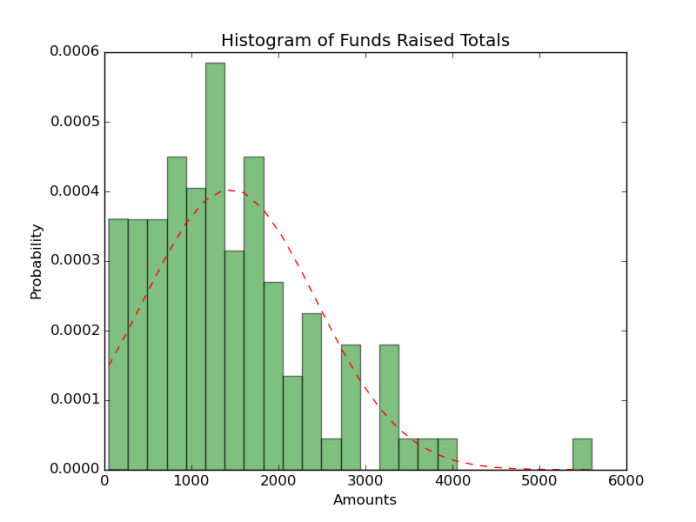
It’s pretty basic, but it does produce interesting looking graphs, and there is a very strong relationship between the key success factors and the projected campaign totals the simulator suggests. Here’s an example running on some test data for a small personal crowdfunding campaign.

example.png

Head over to Crowdfund Calculator and take a look. All feedback welcome!

Standard

Can you apply lean principles to nonprofit fundraising?

I’ve been working in digital fundraising for almost a decade now – and have spent the last five years building Hubbub – a digital fundraising and crowdfunding company. Many of the lean techniques we apply in startups can be applied in fundraising, but there are some crucial differences.

Most of the volume of fundraising that happens today is with major donors – and is correspondingly high touch, highly sequential, and the potential loss attributed to failure is very high. Ever wondered why most of the materials you receive from nonprofits – particularly in the education sector – are so dull and uninspiring? If a strategy or technique or ask doesn’t work with a potential £1m donor, and it alienates them, that is a super expensive mistake. It’ll definitely focus the mind on learning, but it makes experimentation and risk-taking very difficult. And experimentation is the cornerstone of lean principles.

This means most fundraisers have highly conservative, highly sequential approaches – which is highly rational. Whilst it isn’t impossible to apply lean principles here, it is harder.

However, there is a new area of fundraising where lean principles can be applied widely – and that is mass fundraising, typically through digital channels. Today, mass fundraising is attempted one or at most twice a year, in a batch format (telethon, direct mail). Batch formats make learning and iteration hard, as campaign messaging is decided in advance, then the button is pushed on the comms, and there is no feedback loop until the next cycle – by which time a lot of the learning has been lost or forgotten. Engagement rates in mass fundraising are generally very poor, but there aren’t many benchmarks to demonstrate quite how poor – so people are generally happy with their engagement rates.

At Hubbub, we’ve been running whitelabel crowdfunding platforms for universities and nonprofits for a few years (e.g. YuStart), and we have also just started to deploy Giving Day and peer to peer solutions for nonprofits. We have observed that the continuous, light-touch, self-qualifying outreach is a major departure from existing development, advancement and fundraising techniques, and requires skills much more akin to the experience of a small company generating leads, qualifying them, and iterating. As a result, many fundraisers don’t possess the key skills required – the kind of skills more common to the new generation of digital marketers, and also to the older generation of charity campaigners, from movement building, policy change, e-campaigning etc.

Lean principles offer some great guidelines for this new mode of fundraising – encouraging a much more iterative, measured approach, complete with A/B testing, feedback loops and real-time adjustments to tactics and techniques as well as to overall campaign messaging and goals. We think this is going to be a big area both for research and for practitioners in the next decade or so, and we’re keen to hear examples of lean principles being applied to fundraising in the education and nonprofit sectors. In early 2016, we’ll be building some workshops around leveraging these principles, so if you’re interested in finding out more, taking part, or offering your own expertise, then please get in touch.

We’ll be posting loads more in 2016 on this topic and we’re actively seeking collaborators!

Standard

Four steps to Philanthropy: Creating a culture of giving in universities

It’s one of the big questions that all universities are increasingly asking themselves. How do we stimulate and support a culture of giving within our institution?

There are obviously a lot of components, and it would be disingenuous to oversimplify – there are no magic bullets. Culture is about how shared experiences can be developed, maintained and then nurtured into behaviour. Giving programs that rely on this culture therefore need to develop student experience, embed an understanding of the way an institution works, and carve out a hallowed place in the hearts and minds of the young people who pass through their doors.

Inevitably, this requires a lot of time and investment. But there are some simple things you can do today to help enhance your current strategy.

Understand and Engage

The best giving cultures develop when there is a clear understanding of the relationship between students, alumni, staff and the institution. In recent years, with the huge increases in fees in the UK, this relationship has changed, as students increasingly understand the university as a supplier, rather than a partner; and vice versa – the relationship has become more commercial.

This relationship is key: it defines not just current but also lifelong future perspective. In the US, tuition fees have long been higher than they have in the UK. However, there is a considerably more developed giving culture than in the UK, despite the high fees. Why? Well, one reason might be that since many students have benefitted themselves from paying “reduced fees” due to scholarships and bursaries, they feel more inclined to ensure the next generation can benefit in the same way. This opens up some interesting questions about how we can better communicate the value of higher education, and build stronger bonds with the student base.

Universities need to encourage students to get involved in their administration, to understand the funding, staffing and governance, and to feel empowered to make a difference. One of the simplest examples is staffing a telephone fundraising campaign with current students – these not only increase the donation rate from alumni (as alumni better relate to the student calling them than they would to a central fundraiser), but most importantly they help those students making the calls to better understand the institution’s goals, establishing a degree of trust and responsibility as well as conditioning the student to engage with this kind of call in future.

Moving this into the 21st C means looking at involving students and staff in creating digital giving programs and using social media to help an institution’s members and students to become the ambassadorial voice of the institution. At Hubbub, we help organisations use giving days, participation projects and crowdfunding campaigns to help build these relationships.

Inspire Students

In the past 15 years we have seen the likes of JustGiving and more recent competitors dominate the digital giving landscape. JustGiving uses a model of peer-to-peer (P2P) giving, where those wishing to support a charity will, for example, run a marathon or go on a bike ride, encouraging their friends and family to sponsor them with donations that go to the charity in question. Because of the close connections between those doing the “challenge” and the donors, there is a much higher rate of giving than there would have been had the charity simply asked directly. The ability to relate to the individual and to feel a sense of being part of someone’s journey to undertake a challenging and rewarding task is a strong motivator for giving.

This mechanic is behind the reasoning for universities employing students to run their telephone lines during telethon campaigns. Critically, it also needs to be employed in digital giving strategies in much the same way as it is employed on JustGiving. If you wish to inspire someone to give the first time, they need to relate to the cause, and that means giving to someone or something that inspires them. The challenge with universities in particular is that students will not fundraise for their university as they would otherwise on JustGiving, because they do not currently perceive their institution as a nonprofit in need of support.

Whilst that latter fact – about how students relate to their institution – is something that will require substantial education and an entire program to engage students in better understanding institutional motivations and behaviour, we can short-circuit this process. Students may not yet believe that their university needs to receive philanthropic donations, but they do have their own projects, ideas and passions that they believe should be supported. This is where the “content goldmine” is – the inspirational hooks that encourage donors to give, and that set off the chain reaction of giving that universities – particularly in the US – currently depend on.

Reciprocate

Imagine you were a student, looking to raise some money to support your passion – and that with the help of your university, you secured the funds from friends, family and alumni. Your association with the university and its community is a lot more powerful than it was before. You understand that the university is there to help you. You understand that alumni give to students, and that your project was only possible because of their support.

When you leave, you are a lot more likely to consider supporting the future generations.

Those links with future generations are vital to the universities, because they provide the university’s development and alumni relations teams with what they need the most – rich, pre-qualified donor profiles. This data is what drives most major fundraising initiatives, but creating and maintaining it can be an immensely expensive process for a small development office. Digital, social giving changes that – empowering students and staff to become the ambassadors of the institution, responsible for first-line contact and communication with alumni.

Use Alumni Data to Build a Giving Community

If you get this right, the data you acquire is a constant stream of engaged donor leads. The data is rich – often containing job titles, social media accounts, locations, full addresses, donation amounts, motivations for giving etc.

This gives you all you need to invite people to join alumni associations in their region, to establish new ones where you see a particularly rich community, invite business or social sector leaders to mentor current students, or to start engaging high net worth donors or corporate senior managers in your major giving programs. Using giving days, participation projects or crowdfunding programmes, your institution can massively widen your reach and engagement, and generate an entirely new set of leads for your giving funnel.

Summary

Giving platforms are great lead-generation tools for universities today. When they are run well, they encourage engagement, inspire current and former students, and initiate a chain reaction of philanthropic giving. This in turn generates a significant number of high-quality leads at relatively low cost of acquisition, building a pipeline of donor prospects alongside an empowered community.

Standard